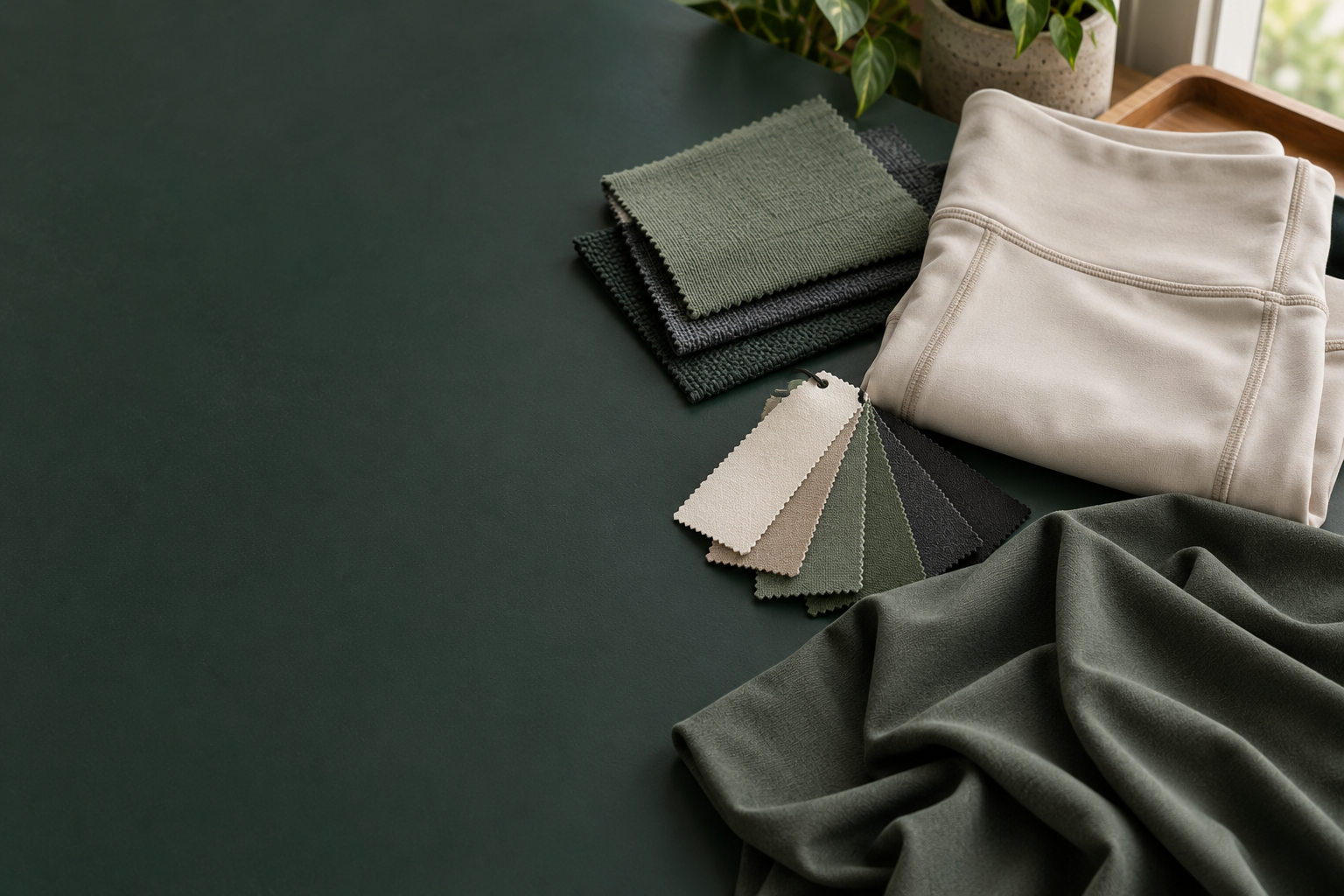
The right yoga-legging fabric must work with the garment pattern, colour, size range and intended movement. A soft swatch or an attractive product photograph is not enough to approve opacity, recovery or comfort. Compare candidate fabrics under the same conditions and record the selected material reference.
Begin with the wearer and activity, compare physical swatches, then review a garment sample in the intended fit and colour. Composition and GSM help describe a fabric; neither alone proves performance.
Write the Use Brief Before Selecting a Blend
Tell the supplier whether the leggings are for studio yoga, mixed training or everyday wear. Explain the desired hand feel, coverage, climate and fit. Separate a visual preference from a performance requirement.
- Soft or brushed, smooth or cool-touch surface direction.
- Desired stretch, support feel and recovery after movement.
- Light and dark colour plans, including any matching top.
- Size range, waistband construction and intended wearing conditions.
Compare Nylon and Polyester as Fabric Systems
Nylon/elastane and polyester/elastane blends are common starting points, but yarn, knit, density and finish change the final result. Do not choose solely from a fibre name or elastane percentage.
- Nylon-based option: ask to compare the actual hand feel, surface, colour and recovery of the proposed construction.
- Polyester-based option: compare the same properties, plus any intended print process and finish.
- For either: request composition, material code, nominal weight and usable width; confirm how these will be controlled for bulk.
Use two labelled swatches of comparable purpose. A comparison between a light brushed fabric and a dense smooth fabric does not isolate the effect of fibre composition.

Read GSM Alongside Structure and Fit
GSM means grams per square metre. It describes mass per area, not a universal quality grade. A higher number is not automatically better for every activity, climate or price point.
Review thickness, density, stretch in both directions and recovery. A fabric may look opaque while relaxed but reveal more when stretched over the body. Pattern tension, seam placement, colour and wearer size all affect the garment result.
Review Opacity and Recovery on the Garment
- Make the sample in the intended material and a relevant colour, not just a convenient substitute.
- Check coverage during the intended movements and under consistent lighting. Review light colours separately.
- Record waistband position, knee and seat recovery, seam comfort and any visible distortion.
- Assess the agreed care procedure and recheck dimensions, surface and shape after laundering.
A visual movement check is a sample review, not a universal “squat-proof” certification. Define the conditions and the acceptance decision in the product file.

Agree Evidence for Performance Claims
If the range will claim moisture management, drying, pilling resistance or another property, agree the method, specimen, conditioning and acceptance criteria before testing. Do not treat a supplier adjective as a result for the final garment.
For terminology, AATCC lists textile test methods, while ASTM lists separate textile methods for properties such as weight, abrasion and pilling. The appropriate method and current edition should be confirmed with the testing provider; MIQI does not assign a pass result from a photograph.

Approve Colour and the Bulk Reference
- Keep the approved swatch, colour reference and material code together.
- For a custom colour, identify the approved lab dip or colour sample and the viewing conditions.
- Review matching tops and bottoms together when they use different constructions.
- Record permitted substitutions and require approval before changing material.
- Confirm any certification against the current scope and selected material; a supplier document is not automatic certification of the finished leggings.
Use the quality checklist to carry these decisions into the order.
Buyer Questions
Is there one best GSM for yoga leggings?
No single value fits every construction, activity and fit. Compare suitable samples and approve the finished-garment result rather than selecting a number in isolation.
Can a fabric photo confirm opacity or quick drying?
No. Photographs can communicate surface and colour direction, but opacity under stretch and drying behaviour require defined sample checks or testing.
Can one fabric be used for an entire set?
Possibly, but top support, lining and construction requirements can differ from leggings. Review each garment and approve the colour relationship together.
RELATED PRODUCT DIRECTIONS
Explore Styles for Your Brief.
Use these styles as starting points. Fabric, fit and branding are developed for your project.
Your Next Step
Review yoga-legging product development and fabric and colour options. Send the activity, feel, size range and colour brief when you request physical material options.